Saltwater Trolling Techniques
Why Trolling Is The Most Effective Offshore Fishing Technique
Trolling is one of the most popular and effective ways to catch big saltwater fish offshore. Why? Because it allows you to cover a wide area of ocean while presenting multiple lures or baits at different depths and distances. Offshore fish like mahi mahi, tuna, wahoo, and marlin are often spread out and moving fast.
Anchoring in one spot rarely works. By trolling, you move your boat slowly and pull lures or baits behind it. This imitates a school of baitfish—a favorite meal for predators.
Another reason trolling is so effective is that it enables you to target different species at the same time. By adjusting your trolling spread, speed, and lure types, you can attract different fish even on the same pass. Many record-breaking catches have been made by trolling. If you want more strikes and bigger fish, learning the right saltwater trolling techniques is essential.
The Basics Of A Trolling Spread
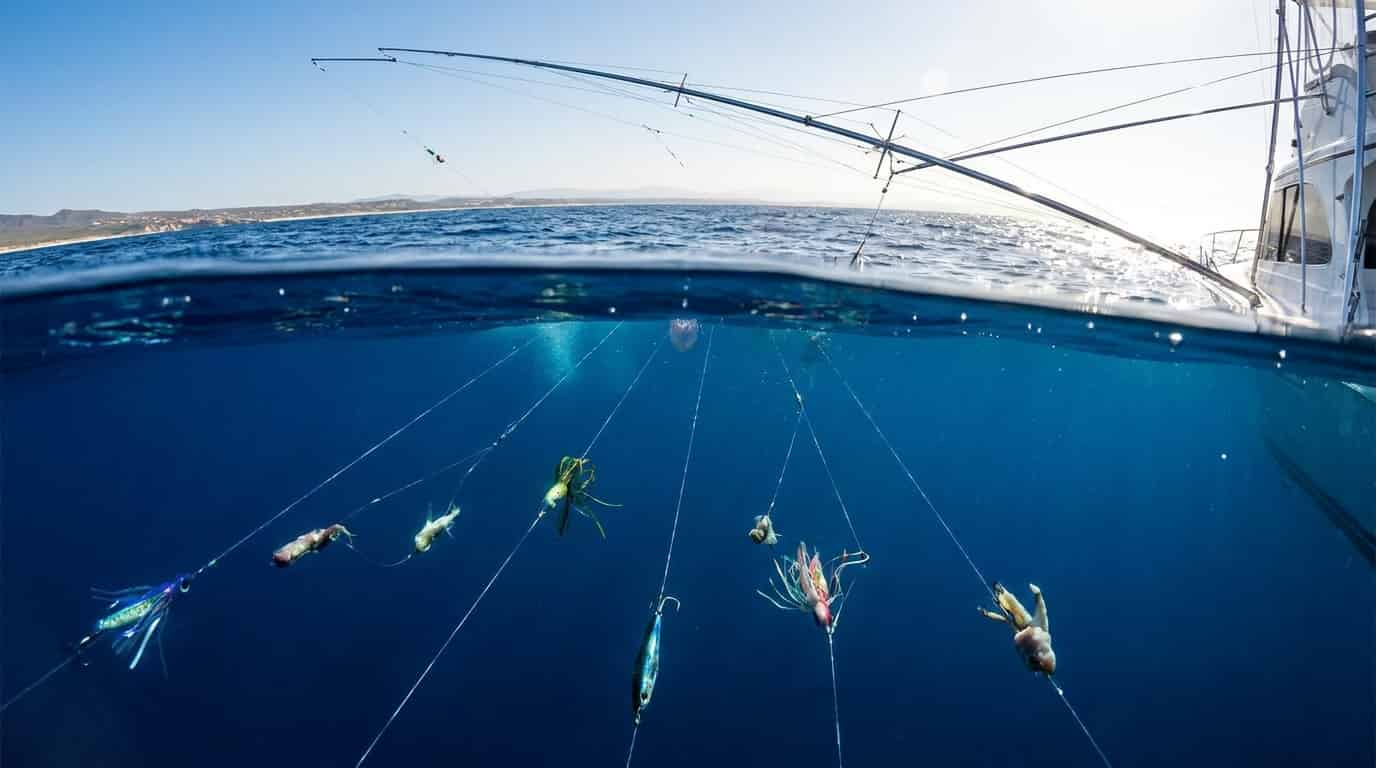
The foundation of successful trolling is a well-organized trolling spread setup. This refers to the way you arrange your lines and lures behind the boat. The goal: avoid tangles, imitate a natural bait school, and cover different depths and distances.
A typical trolling spread uses three main positions: flat lines, outrigger lines, and a center rigger. Each has a specific role and works best for certain lure types or baits.
Flat Lines
Flat lines are the simplest and most direct lines in a trolling spread. They run straight off the stern (back) corners of the boat, parallel to the water’s surface and without special equipment. Flat lines are usually set closest to the boat—about 20–40 feet back. This position is perfect for lures or baits that mimic injured fish, as the boat’s turbulence can make them look more vulnerable.
Pro tip: Use heavier tackle here. Fish that strike flat lines often hit with power, and they’re close to the engine noise.
Outrigger Lines
Outriggers are long poles mounted to each side of the boat. Their job: spread your lines wider, so you can run more lures without tangling. Outrigger lines are run farther back than flat lines—often 50–100 feet or more. By placing lures in clean, undisturbed water, outriggers make your baits more visible and natural to predators.
Outrigger clips also allow you to adjust the release pressure, so when a fish strikes, the line pops free for a clean hookset.
Center Rigger
The center rigger is a single, tall pole mounted at the boat’s stern or on the T-top. It lets you run a line right down the middle, behind all the other lures. The center rigger is usually the longest line in your spread, set 100–150 feet back. It’s ideal for shy or wary fish, as the lure sits far behind the wake and prop wash.
Using all three positions gives your trolling spread a “V” shape, covering more water and increasing your odds of a strike.
How To Set Up A 5-line Trolling Spread
A 5-line spread is a favorite for many offshore anglers. It offers broad coverage but is still manageable for two or three people. Here’s how to set it up:
- Port Flat Line: Set close behind the boat on the left (port) corner.
- Starboard Flat Line: Same as above, but on the right (starboard) corner.
- Port Outrigger Line: Run this line wider and farther back on the left outrigger.
- Starboard Outrigger Line: Mirror the port outrigger on the right side.
- Center Rigger Line: The longest line, right down the middle.
This setup allows you to present lures at different distances, depths, and positions. For example, try using a diving plug or weighted bait on one flat line, a surface lure or skip bait on the other, and various lures or daisy chains on the outrigger and center lines.
Spacing is key. Stagger each lure so they don’t run in a straight line. For example, set your port flat line at 30 feet, starboard flat at 40 feet, port outrigger at 70 feet, starboard outrigger at 90 feet, and center rigger at 120 feet.
Adjust these distances based on your boat’s wake and water conditions.
Trolling Speed For Different Species
Trolling speed is critical for attracting the right fish. Too slow, and your lures look unnatural; too fast, and many species will ignore them. The ideal speed depends on your target species, lure type, and sea conditions.
Here’s a quick reference for common offshore species:
| Species | Ideal Trolling Speed (knots) | Common Lure Types |
|---|---|---|
| Mahi Mahi | 5–8 | Feathers, small plugs, ballyhoo |
| Yellowfin Tuna | 6–9 | Jet heads, cedar plugs, squid chains |
| Wahoo | 8–15 | High-speed lures, deep divers |
| Marlin/Sailfish | 7–9 | Large skirted lures, rigged ballyhoo |
Small changes in speed can make a big difference. For example, if mahi mahi are ignoring your lures at 7 knots, try slowing down to 5. 5 or speeding up to 8. Wind, current, and lure design also affect how a lure swims.
Adjust your throttle until you see the right action behind the boat.
Lure Position And Depth In The Spread
Lure position is about more than just distance behind the boat. You must also consider depth. Different fish feed at different levels, and a good trolling spread covers both surface and subsurface zones.
- Flat lines are best for surface or shallow-running lures, such as chuggers, poppers, or live bait.
- Outrigger lines can be used for both surface and mid-depth presentations, especially when paired with weighted heads or planers.
- The center rigger is usually reserved for long, surface-skipping lures or teasers.
If you want to fish deeper, add a trolling sinker, planer, or use a lure designed to dive. For example, a 12-ounce sinker or No. 2 planer can get your bait 20–40 feet below the surface—where wahoo and tuna often hunt.
Here’s a simple comparison:
| Line Position | Typical Depth | Best For |
|---|---|---|
| Flat Line | Surface to 5 ft | Mahi mahi, kingfish |
| Outrigger Line | Surface to 15 ft | Tuna, wahoo, sailfish |
| Center Rigger | Surface | Marlin, sailfish |
Tip: Watch your lures as you set your spread. If one keeps popping out of the water or spinning, adjust the weight or position until it swims naturally.
Using Teasers And Daisy Chains
Teasers and daisy chains are critical tools for offshore trolling. They do not have hooks but are designed to attract fish to your spread by creating extra flash, splash, and commotion.
- Teasers are large, flashy lures or objects (like birds, squid bars, or big soft plastics) pulled close to the boat.
- Daisy chains are strings of smaller lures or baits tied in a line, often ending with a single hooked bait.
Teasers and daisy chains work by mimicking a school of baitfish fleeing from predators. They bring curious fish into your spread, where they spot your real baits or lures. Many captains run a teaser on a short line in the prop wash or a daisy chain off the center rigger.
A good saltwater trolling guide will tell you: never let your teasers block the view of hooked lures. Position teasers so they attract fish but keep the hooked baits easy to spot.
Trolling For Mahi Mahi
Mahi mahi (also called dolphin or dorado) are a favorite target for offshore trollers. They are fast, aggressive, and travel in groups. Their bright colors and leaping strikes make them exciting to catch.
When trolling for mahi mahi:
- Use small to medium lures (4–8 inches) in bright colors like green/yellow or pink/white.
- Feather lures, small skirted baits, and rigged ballyhoo are top choices.
- Troll at 5–8 knots along weed lines, floating debris, or color changes in the water.
- Place at least one lure close to the boat (flat line) and another far back (center rigger) to cover the water column.
For best results, look for birds diving or flying low. This often means baitfish are present and mahi mahi are feeding. If you hook one, keep it in the water—a school often follows, and you may catch several more.
Non-obvious tip: Mahi mahi are attracted to noise and splashing. Adding a popping plug or splash teaser to your spread can trigger more strikes.
Trolling For Yellowfin Tuna
Yellowfin tuna are strong, fast, and travel in schools. They are often found near temperature breaks, current edges, and floating objects. Tuna can be finicky, so presentation and lure choice matter.
- Use jet heads, cedar plugs, squid chains, or small skirted lures.
- Troll at 6–9 knots.
- Place at least one deep-diving lure or use a planer to get below the surface.
- Pay attention to birds, dolphins, or surface action—tuna often feed with them.
Yellowfin often strike outrigger lines or lures farther back in the spread. If you see tuna jumping but get no bites, try downsizing your leader or switching to darker lure colors.
Pro insight: Tuna have excellent eyesight. In clear water, use fluorocarbon leaders and keep your boat’s shadow off the spread.
Trolling For Wahoo
Wahoo are the speedsters of the offshore world. With razor-sharp teeth and explosive strikes, they require special tactics.
- Troll fast: 8–15 knots is common.
- Use high-speed lures, deep-diving plugs, or rigged ballyhoo with wire leaders.
- Run at least one line deep, using a trolling sinker or planer.
- Target drop-offs, ledges, or temperature breaks where wahoo hunt.
Wahoo often strike the fastest or deepest lures in the spread. Always check your leaders for damage after each bite—they can slice through mono in seconds.
Non-obvious insight: Wahoo often hit on the turn, when the inside lures slow and the outside speed up. Add a zig-zag to your trolling path for more bites.
Trolling For Marlin And Sailfish
Marlin and sailfish are the ultimate offshore prizes. They are large, powerful, and attracted to splashy, surface-skipping lures.
- Use large skirted lures (8–14 inches) in blue, pink, or purple.
- Rigged ballyhoo with circle hooks are also effective.
- Troll at 7–9 knots in deep blue water, near drop-offs or temperature changes.
- Spread your lures to cover all wake zones—flat lines, outriggers, and center rigger.
Marlin and sailfish often appear behind the teaser or daisy chain before striking a bait. Always have a pitch bait or live bait ready for a quick drop-back.
Pro tip: Use a center rigger for your longest and most visible lure. Marlin often follow the spread before attacking the last lure.
How To Handle A Strike While Trolling
Getting a strike is thrilling, but landing the fish takes skill. Here’s how to react:
- Don’t grab the rod immediately. Let the fish eat and turn with the bait—especially with ballyhoo or circle hooks.
- Watch the line. If it snaps out of the outrigger or rigger clip, pick up the rod and smoothly increase pressure.
- Keep the boat moving forward. This keeps tension on the fish and avoids slack line.
- Clear unused lines. If a big fish is hooked, reel in other lines to prevent tangles.
- Communicate. The driver and anglers should talk—move rods and lines as needed to follow the fish.
- Use smooth, steady pressure. Pump the rod to gain line, and keep the tip up.
- Be ready for runs. Offshore fish make powerful, fast runs. Let them go, then recover line as they tire.
A common beginner mistake: jerking the rod or reeling too fast. Let the rod and drag do their work. Many fish are lost in the first minute due to panic or slack line.
Frequently Asked Questions
What Is The Best Trolling Speed For Mahi Mahi?
The ideal trolling speed for mahi mahi is 5–8 knots. Try different speeds between 5 and 8 knots to see what gets the most strikes. If the water is rough or you are using natural baits, stay on the slower side.
How Far Behind The Boat Should I Set My Trolling Lines?
Line distance depends on the type:
- Flat lines: 20–40 feet behind the boat
- Outrigger lines: 50–100 feet
- Center rigger: 100–150 feet
Stagger the lines so lures don’t run in a straight line. Adjust these based on your boat’s wake and lure action.
What Is A Daisy Chain And Why Should I Use One?
A daisy chain is a set of lures or baits connected in a line, often ending with a single hook. It creates the illusion of a small school of fish. Daisy chains are great for attracting mahi mahi, tuna, and billfish to your spread.
How Do I Prevent Tangles When Trolling Multiple Lines?
To avoid tangles:
- Use outriggers and a center rigger to spread lines wide and long.
- Stagger lure distances.
- Keep boat turns wide and slow.
- Check lures regularly for weeds or debris.
Can I Troll And Bottom Fish On The Same Trip?
Yes, but you should separate your gear and tactics. Troll while searching for fish or moving between spots. When you find good structure or fish on sonar, stop and switch to bottom fishing. Combining both methods makes for a productive day offshore. For more advanced tips, check Salt Water Sportsman.
Saltwater trolling is a dynamic and exciting technique that can produce amazing catches. By understanding your trolling spread, adjusting speed and lure position, and reacting quickly to strikes, you’ll increase your chances of landing trophy fish. Remember, experiment with your setup, learn from every trip, and stay patient—offshore trolling rewards the angler who adapts to changing conditions.
With practice and the right knowledge, you’ll be ready to enjoy the best that offshore fishing has to offer.
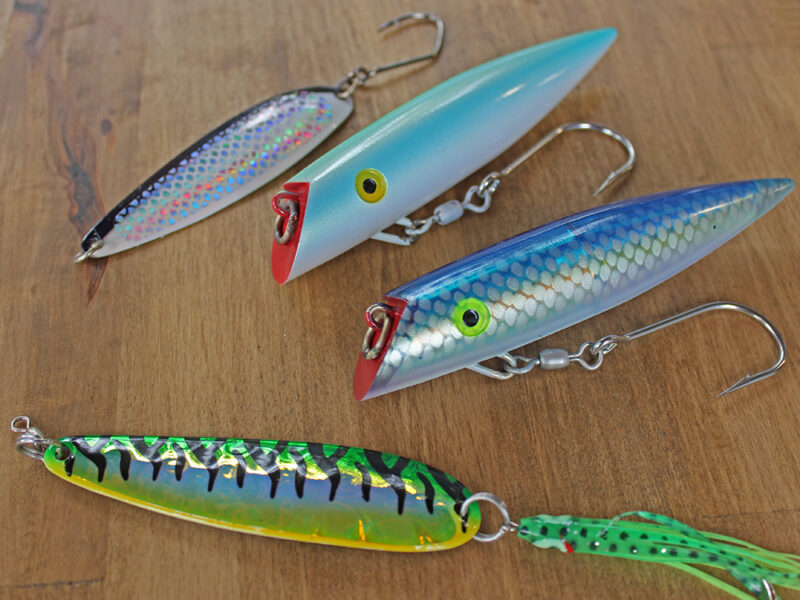
Credit: riptidefish.com
Tony L. Smith is a dedicated fishing expert with over 15 years of hands-on experience in freshwater and saltwater environments. As the founder of FishingStaff, Tony is committed to demystifying fishing gear for beginners and budget-conscious anglers who refuse to compromise on quality. Learn more about Tony & find him on Twitter. Happy reading!